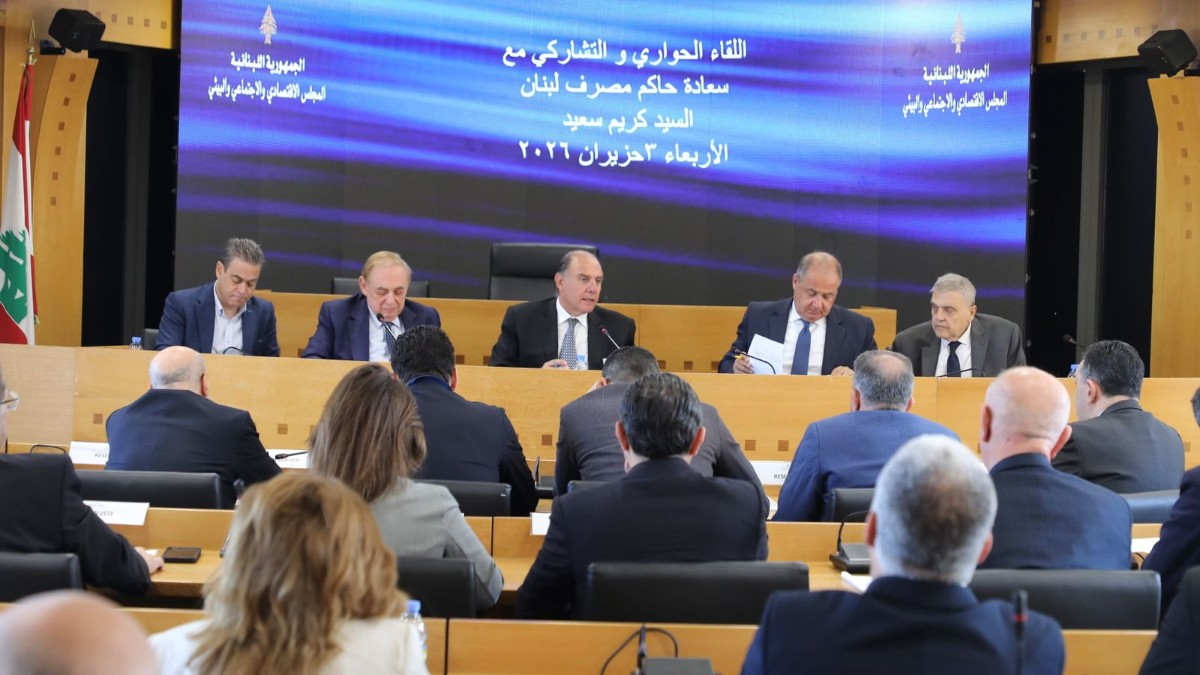
The Economic, Social, and Environmental Council held a dialogue and consultative meeting with the Governor of the Central Bank of Lebanon, Karim Saeed. The meeting was attended by MPs Farid Boustani, Nicolas Sehnaoui, Tony Frangieh, Faisal Sayegh, Amin Sherri, Michel Doueihy, Wadah Sadek, Elias Hankash, and Razi Hajj; the Director of the Economic and Social Council, Dr. Mohammad Saifeddine; the President of the Beirut Traders Association, Nicolas Chammas; the President of the Maronite League, Engineer Maroun Helou; the Chairman of the Board of Directors of the Investment Development Authority of Lebanon (IDAL), Dr. Majed Mneimneh; and the Vice President of the Capital Markets Authority, Dr. Mahmoud Jbaai.
Arbid
Arbid spoke about "the importance of the anticipated amendments to the draft law on restoring financial order and recovering deposits, and their impact on the course of financial and economic recovery," emphasizing "the necessity of protecting depositors' rights and approving mechanisms for deposit recovery in light of the recent developments in the proposed reform projects."
He emphasized "the importance of revitalizing lending to the private sector as a means to stimulate growth and investment and restore the economic cycle, as well as the gradual transition from a cash-based economy to one more reliant on digital payments and modern financial services."
Saeed
For his part, the Governor of the Central Bank of Lebanon said: "Six years have passed since the financial and banking collapse became undeniable, six years of paralysis, disruption, and conflict, and of daily pressures coming from all directions: from the state, from Parliament, from the banks, and from the International Monetary Fund. And above all, from the legitimate demands of depositors who entrusted this system with their life savings."
He presented "a systematic overview addressing the diagnosis of the crisis, the proposed solutions, the required legislative framework, and a realistic timeline, in addition to the fundamental facts without which no successful solution can be achieved." He added: "The financial and banking crisis in Lebanon is, technically speaking, a systemic crisis in every sense of the word, and it has been described as such by numerous experts both locally and internationally. The International Monetary Fund has also recently acknowledged this."
He pointed out that "the issue is not about the failure of one bank, or even a number of banks, but rather a simultaneous collapse of the state's financial capacity, the financial standing of the Central Bank of Lebanon, the liquidity of the banking sector, and public confidence, such that all these elements have become mutually reinforcing, leading to a comprehensive collapse." He added, "The basic facts in this context are undeniable: approximately $80 billion in losses in the banking sector, most of which were deposited by banks with the Central Bank of Lebanon; the state's default on Eurobonds in March 2020, coinciding with the collapse of the value of Lebanese lira treasury bonds, which were worth twice the value of the Eurobonds; the collapse of the national currency's exchange rate by more than 98%; the emergence of parallel markets operating outside legal frameworks; six years of paralysis without a restructuring law, a recovery plan, or a clear reform path; the 2024 war, which added further destruction to what already existed; and then the ongoing war in 2026."
He asked: "How did we get here?" He said: "The financial model adopted by Lebanon after the civil war was based on a continuous series of unsustainable refinancing operations. The fixed exchange rate and high interest rates attracted deposits from Lebanese at home and abroad, in addition to regional deposits, and then these funds were recycled through the banks to the Central Bank of Lebanon, and through the Central Bank of Lebanon to the state, which was suffering from a recurring financial deficit." This model was only sustainable as long as inflows exceeded outflows, but with the erosion of confidence in 2019, the collapse was swift and comprehensive.
He added: “The failures exacerbated the crisis and its complexities. Successive governments dealt with the public treasury without accountability or responsibility, and the regulatory environment facilitated recourse to financial engineering while systemic risks accumulated. There was a lack of independent auditing and effective oversight, and corruption was not a marginal phenomenon but rather at the very heart of the system.”
He continued: “From its first day in office on April 4, 2025, the new administration of the Central Bank of Lebanon declared that this crisis was systemic, and the aim was not to absolve any party of its responsibilities. We clearly affirmed that the state, the Central Bank of Lebanon, and commercial banks bear responsibility for the financial and banking crisis, and that they must all share the burden of addressing it. We insisted on this characterization because of the necessity for technical precision, as the diagnosis determines the treatment.” Each side interpreted this situation in a way that suited them, and that was of no concern to us. We do not take positions to please any party, but rather to state the facts as we see them. Popular contests are the domain of politicians, not technocrats like central bank officials. Our duties, from the bailiff to the governor, are not affected by any decision, article, public or private stance, threat, or inducement. The sole overseer of the Central Bank of Lebanon is the judiciary.
He added, "The official recognition of the systemic nature of this crisis, whether by the Central Bank of Lebanon or the International Monetary Fund, does not absolve anyone of responsibility. The state, the Central Bank of Lebanon, and commercial banks all bear varying shares of responsibility, each according to its role and contribution to the emergence of the crisis." He continued, "What the systemic framework of this crisis allows is a fair basis for distributing the burdens, ensuring that the entire cost of addressing it does not fall on depositors, who are simultaneously the least responsible for the crisis and the most affected by its consequences. This is not merely a financial principle, but a moral obligation and the foundation of social justice, a position to which the Central Bank of Lebanon has adhered publicly and consistently since day one."
He continued: “In Cyprus, for example (2012-2013), the economy was excessively and unduly exposed to Greek sovereign debt. When Greek debt was restructured, Cyprus entered a severe crisis. This was followed by the implementation of the bail-in mechanism, which sparked much controversy, but it was painful and decisive, and the crisis was resolved within three years.”
He pointed out that "a radical and swift solution leads to a faster recovery than a gradual and prolonged drain," adding, "In Iceland (2008), banks whose size was roughly ten times the size of the national economy collapsed under the weight of speculative international lending, and the Icelandic authorities' response was remarkable. They let the failing banks face their fate, protected local depositors, and prosecuted those responsible. This resulted in the imprisonment of 26 bankers."
He explained that "recovery came faster than in all the countries that opted for costly bailouts," considering that "accountability is not an option, but a fundamental pillar in any reform process." He added, "Greece (2010-2018) endured a full decade of austerity as a result of undisciplined fiscal policies, the repercussions of which were concealed behind accounting practices that would have impressed even the most skilled deceivers. Reform was constantly promised, but it was also constantly postponed."
He stated that "political dysfunction not only delays recovery, but also transforms into a crisis in itself," asking, "Where does Lebanon fall within this classification of crises?" He said, "In reality, it doesn't fall into any of them. In all the cases we reviewed, the original sin was committed by the commercial banking sector, while the state, despite the shortcomings in its practices, merely played the role of savior in the end. In Lebanon, however, due to financial recklessness and rampant, systematic borrowing, the state was the main player in this national tragedy." All other beneficiaries and participants became either key agents, like the Central Bank of Lebanon, or de facto partners, like commercial banks.
He explained that "the Lebanese crisis did not originate in the private sector, but was a crisis initiated by the public sector and engineered over decades to finance a chronic and structural fiscal deficit through a mechanism that demonstrated a profound disregard for risk." He added, "The state borrowed from the Central Bank of Lebanon in Lebanese lira and US dollars at interest rates that no country should have to pay. The Central Bank offered commercial banks exceptional returns in exchange for depositing their funds with it, and the banks accepted, driven by the pursuit of excessive profit. The regulatory and supervisory body, the Central Bank of Lebanon, failed to fulfill its responsible and precautionary role. Instead, it acted as a financial intermediary, facilitating transactions between a state lacking fiscal discipline and a banking sector ready to exploit this situation, while systemic risks accumulated until they reached catastrophic levels."
He added: "The warning signs were there. They were issued by independent economists and credit rating agencies. But these warnings didn't come from the Central Bank of Lebanon, the Ministry of Finance, the Ministry of Economy, or the Association of Banks, and they fell on deaf ears because a large number of parties were reaping huge financial gains. As for the depositors—teachers, engineers, professionals, retired military and civilian personnel, as well as expatriate families who sent money home—they weren't partners in this scheme, especially small and medium-sized depositors. Instead, they were the fuel that kept it running. And when the engine exploded, they were asked to bear the consequences of the wreckage."
He pointed out that "this disparity in responsibility forms the ethical and legal basis for the Central Bank of Lebanon's position on the principle of burden-sharing," adding, "The state bears primary responsibility, while the Central Bank of Lebanon bears a responsibility that almost equals and rivals that of the state, due to its failure to fulfill its role as a regulatory body overseeing the banking sector and as the state's bank, bound by the requirements of sound financial management. Commercial banks, which benefited from this situation and profited from it, also bear a responsibility they cannot evade by claiming they were forced into it due to limited investment opportunities abroad, or by acting merely as a financial instrument or a detached intermediary between depositors and the central bank or the state. As for the depositors, they bear no direct responsibility; rather, they are the victims of this collapse."