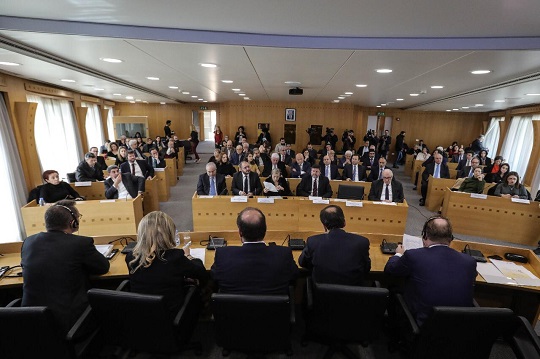
The Economic and Social Council launches the project “Building Consensus on Economic and Social Reform in Lebanon” in cooperation with the OECD
The Economic and Social Council today launched the project “Building Consensus on Economic and Social Reform in Lebanon”, in the presence of Minister of Economy and Trade Dr. Mansour Bteich, Minister of State for Administrative Development Dr. May Chidiac, German Ambassador to Lebanon Dr. Georg Birgelen, and Mr. Andreas Schaal, Head of the International Relations Secretariat at the Organisation for Economic Co-operation and Development (OECD).
The project, funded by the German Foreign Ministry, consists of a training program for members of the Council. It will be implemented by the OECD within the framework of its Middle East and North Africa Initiative on Governance and Competitiveness for Development.
Minister May Chidiac stressed the need for consensus among all Lebanese, given the severity of the situation and the difficult economic and living conditions affecting citizens. She underlined the importance of not transferring political conflict into economic and social issues, calling for no wasted time and for proceeding with bold and structural reforms in the state, and for turning words into action.
She also affirmed her commitment, as Minister of State for Administrative Development, to working with the OECD to move Lebanon toward the concept of open government, integrating e-government, transparency in the public sector, and citizen participation in monitoring state performance, in line with the implementation of the CEDRE commitments as a rescue plan for Lebanon in this difficult phase.
For his part, Minister of Economy Mansour Bteich said: “You are launching this project today from the heart of the Economic and Social Council, which I had the honor of chairing its General Economic Affairs Committee, and I know the seriousness with which it addresses the issues raised before it. Your project complements initiatives being undertaken by the Lebanese state and provides technical expertise on important issues such as anti-corruption, ensuring the highest levels of transparency and governance, and the right of access to information.”
He added that he took the opportunity to thank the OECD for its technical support to Lebanon, its workshops on sensitive issues including investment promotion and the development of the real economy across various sectors, as well as the German Foreign Ministry for funding the project. He noted that the project is titled “Building Consensus on Economic and Social Reform”, emphasizing that reform has become the government’s guiding principle as it moves toward building a national consensus that strengthens Lebanon’s economy and its resilience.
The President of the Economic and Social Council, Chawki Abillama, praised the importance of this promising project in cooperation with the OECD, noting that the Council has launched a new dynamic of work since its formation a year and a half ago. This has been reflected through its ten specialized committees covering economic and social affairs, productive sectors, human rights, youth and sports, science and technology, tourism, environment, agriculture, labor, professions and crafts.
He added that the Council has also begun working on social dialogue by engaging all relevant stakeholders to strengthen social cohesion and reduce tensions. In line with this approach, the Council is currently preparing four specialized studies on housing policies, unemployment and job creation, technology-related employment, and vocational and technical education and training.
He further explained that the Council is working to launch a broad social dialogue not only among productive forces but across the widest possible range of society’s components, including political parties and civil society organizations. He called on the new government to support the Council’s efforts by organizing national social dialogue sessions, with the Council committed to ensuring broad participation and engagement.
He expressed hope that this project, implemented in cooperation with the OECD, will strengthen the Council’s capacity to structure social dialogue through seminars, peer-learning sessions, knowledge exchange, and other opportunities provided by the initiative.
The German Ambassador stated that Germany, as one of the main donors in Lebanon, is proud to support this project between the ESC and the OECD, which aims to engage the private sector in building consensus around the country’s reform plan.
Andreas Schaal, Head of the OECD International Relations Secretariat, emphasized that Lebanon has strong potential and significant advantages, including its relatively diversified economy, openness, and strong private sector. He noted that reform processes are complex everywhere and always face resistance, but dialogue remains the key tool to overcoming these challenges.
He stressed that effective dialogue requires structured institutions capable of bringing stakeholders together, highlighting the important role of the Economic and Social Council in this regard.
The event opened with a welcoming speech by Anis Bou Diab, member of the Economic and Social Council, who emphasized the importance of the project in enhancing the Council’s capabilities and strengthening its role in influencing balanced economic, social, and environmental policies.
It is worth noting that the project will include a series of seminars, the first titled “Institutions for Strengthening Social Dialogue”, focusing on economic and social councils, methodologies, tools, and procedures. The second part, titled “The Economic and Social Council as a Catalyst for Consensus in Lebanon after the CEDRE Conference”, will focus on Lebanon’s policy priorities and combine methodological aspects with dialogue on key policy issues, including anti-corruption, integrity, market access, information transparency, the social impact of financial reforms, and business environment reforms.